
Last weekend, my daughter-in-law and I built a five-foot animated Ground Breaker Reaper.
You know. Normal family bonding.
We started with a pile of black metal poles, wires, plastic body parts, fabric, electronics, a giant skull and approximately 47 things that looked like they could absolutely be attached to the wrong thing.
I opened the instruction book fully expecting the usual assembly experience.
Step 1: confidence.
Step 4: confusion.
Step 7: questioning every decision that brought you to this moment.
And then something strange happened.
It was easy.
Not because the reaper was simple. It definitely wasn’t.
It had a metal frame, shoulder pieces, head supports, wiring, a control box, moving components and enough assorted hardware that the finished product had no business being as straightforward to assemble as it was.
The difference was the way the manufacturer had designed the instructions.
Everywhere we looked, the answer was already there.
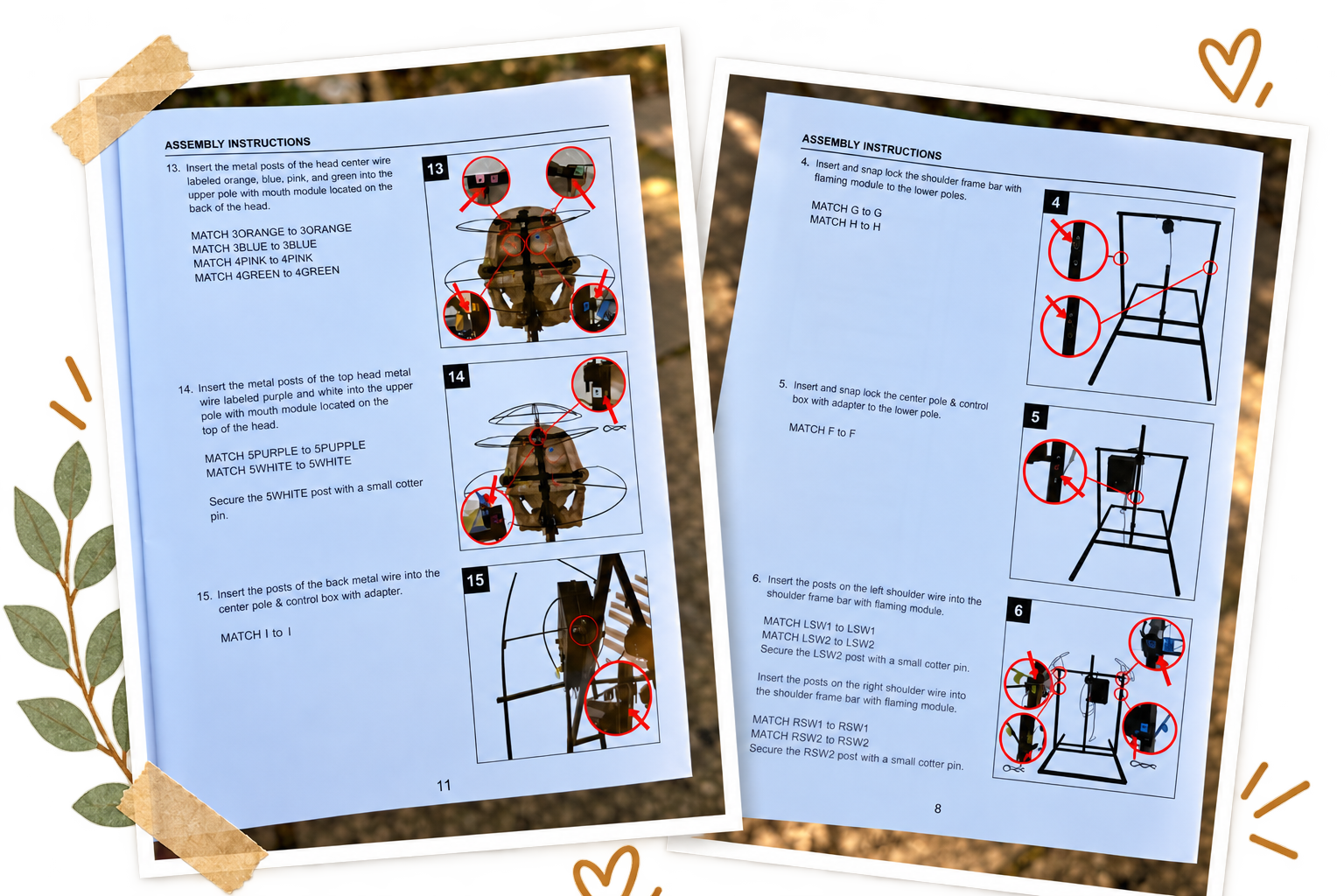
Sometimes excellent Tool Support really is this simple: G goes to G.
G connects to G.
H connects to H.
Then we reached the head.
3 ORANGE connects to 3 ORANGE.
3 BLUE connects to 3 BLUE.
4 PINK connects to 4 PINK.
4 GREEN connects to 4 GREEN.
There were labels on the parts, labels on the connection points, color coding, pictures, arrows and close-up images showing exactly where everything belonged. At some point, I realized we weren’t really having to figure anything out. We were mostly just matching things.
And I thought: This is an absolutely brilliant example of Tool Support.
Somebody designed out the confusion
That’s the part that stuck with me. The manufacturer could have shipped the exact same pieces with instructions that said something like, “Insert the head center wire into the corresponding upper-pole mounting locations.”
Technically correct, but not especially helpful when you’re standing in the yard holding two black metal rods that look almost identical.
Instead, somebody thought about the person who would eventually assemble this thing. They considered where we might get confused, which pieces looked alike, where we might attach something incorrectly and what we would need to see at that exact moment.
Then they built those answers into the product.
They didn’t depend on us being experienced animatronic-reaper assemblers, and they didn’t expect us to memorize how the whole thing worked before we could put it together. They made the right action obvious, which is exactly what strong Tool Support should do.
Now think about how we design work
This is where my mind immediately went, because workplaces routinely do almost the opposite.
Someone misses a step in a process, selects the wrong option, enters something in the wrong place, forgets a requirement or does something differently from another employee. The response is often some version of, “They’ve been trained,” “It was in the email,” or “They should know this by now.”
Maybe they should.
But I’d still want to ask another question: How easy did we make it for them to do it correctly?
Knowing something and being able to reliably execute it inside a complicated work environment are not the same thing.
Imagine assembling this thing at work
Picture our giant reaper again, except this time there are no letters on the poles, no colors, no arrows and no close-up pictures.
The instructions are stored on a shared drive. They’re 38 pages long, the person who originally wrote them left the organization three years ago, and someone updated part of the process last year but never updated the document.
There’s also a spreadsheet, although nobody is completely sure which version is current. When you finally ask a coworker what to do, they say, “Oh, I don’t do it that way. Here, I’ll show you.”
Congratulations. We’ve recreated a surprising amount of modern work.
Then when someone connects 3 BLUE to 4 GREEN, we schedule retraining.
Sometimes we’re training around a design problem
Training matters. People need knowledge and skills to perform their jobs, and there are plenty of situations where training is absolutely the right intervention.
But sometimes we ask training to compensate for work that has been designed in a way that makes success harder than it needs to be.
Something goes wrong, so we train people again. It happens again, so we send a reminder. It happens again, and now someone wants an annual refresher or another mandatory e-learning module.
At some point, we should probably stop and ask whether people actually need more training or whether the process itself could be redesigned.
Maybe we don’t need another course.
Maybe we need a giant blue 3 next to the thing that connects to the other giant blue 3.
I’m only half kidding.
Good tools carry some of the mental load
One reason those Halloween instructions worked so well is that they didn’t require us to remember much. The information we needed was right there at the moment we needed it.
That matters because people already carry an enormous amount of mental load at work. They’re managing emails, deadlines, interruptions, customers, meetings, documentation, changing priorities, technology, coworkers and a thousand little decisions competing for attention.
Then we create a process that depends on someone remembering six arbitrary steps from something they learned four months ago, and we’re surprised when step five occasionally disappears.
The reaper didn’t care whether I remembered which shoulder wire went where. The environment carried that information for me.
LSW1 connected to LSW1.
That freed us up to assemble the thing instead of using our attention to decode the process.
Tools are much bigger than technology
When I talk about Tool Support as one of the six JL³ Performance Levers, people may immediately think about software, equipment or systems. Those things matter, but Tool Support is much broader than that.
A checklist is a tool. So is a template, decision tree, visual guide, script, label, dashboard, automated reminder, reference card or well-designed form. Even the way information is organized on a screen can either support performance or make the work unnecessarily difficult.
The question isn’t simply whether employees have tools. The better question is whether those tools actually help them perform the work.
A 60-page manual is technically a tool, but that doesn’t mean it’s useful when someone needs an answer in the next 30 seconds.
Pay attention to the workarounds
I also pay attention when employees start creating their own tools.
The homemade spreadsheet, the sticky note stuck to the monitor, the cheat sheet tucked in a drawer, the saved email template or the Word document called “HOW TO ACTUALLY DO THIS” are all telling you something.
Usually, the employee has encountered friction in the official process and created something to compensate for it.
Sometimes those homemade tools are excellent. Sometimes they create additional risk because everyone is now working from their own version of the process.
Either way, I’d want to know why the workaround exists before I eliminated it.
What problem did it solve? What was hard to remember? What information was difficult to find? What part of the official process wasn’t giving people what they needed?
Those answers can tell you a lot about where Tool Support is breaking down.
The point isn’t to remove thinking from work
None of this means we should try to turn every job into a paint-by-number exercise. Plenty of work requires judgment, creativity, empathy, analysis and complex decision-making.
In fact, that’s exactly why I don’t want employees wasting mental energy trying to remember arbitrary administrative steps when the environment could carry that information for them.
I want people using their brain for the parts of the job that actually require a brain.
The reaper instructions didn’t remove the work. We still had to build the thing. They removed a lot of the unnecessary ambiguity surrounding the work.
That’s a very different thing.
By the end, we had a giant skeleton
Eventually, our collection of poles, wires, fabric and questionable-looking body parts turned into a five-foot hooded skeleton looming over the front yard.
One thing I noticed was that we kept moving. There weren’t many moments where we had to stop and ask what something meant, where something went or whether we had done the last step correctly.

Our finished five-foot Ground Breaker Reaper. Much easier to assemble than it looks.
That matters more than it might sound.
Work feels very different when the environment supports you. The pathway is visible, the next step is clear and the information you need appears when you actually need it.
Not every job can be reduced to matching colored numbers, of course, but every organization can look more closely at the friction it has unintentionally built into the work.
So the next time someone isn’t performing a task consistently, before asking “Why can’t they get this right?”, I’d ask something else first:
How easy have we made it to get this right?
You may discover that you don’t need another training.
You need a better tool.
And apparently, sometimes it takes a giant animated Halloween skeleton to make that painfully obvious.
Happy Halloween. 🎃
Tool Support is one of the six JL³ Performance Levers. When performance stalls, the problem may not be the person at all. Sometimes the conditions around the work are making success harder than it needs to be.